Ain Dar Fire Tests Saudi Oil Shield
A heat anomaly and smoke report near Ain Dar has raised concern about Ghawar and the East-West Pipeline, but claims of a coordinated triple strike remain unverified.
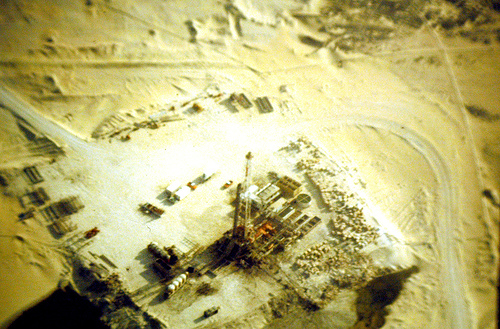
A fire or significant heat source reported near Ain Dar in eastern Saudi Arabia has generated claims that Yemen’s Houthis struck another core part of the kingdom’s oil network. Ain Dar belongs to the wider Ghawar system and sits near infrastructure connected to Saudi Arabia’s cross-country export architecture, making the location strategically important even before the cause is known.
Open-source posts cite smoke and a NASA FIRMS thermal anomaly near coordinates south of the field. FIRMS is a valuable tool that detects heat through satellites, but it cannot tell users whether the source is a missile impact, industrial flare, brush fire or controlled burn. A red point on a map is a lead for investigation, not an attribution mechanism.
The viral narrative presents Ain Dar, Abqaiq and Yanbu as three nodes hit in one coordinated campaign: upstream production, central processing and Red Sea export. That targeting logic is coherent. It is also exactly the kind of coherent story that can lead analysts to fit uncertain observations into a desired pattern.
Ain Dar’s true operational importance depends on which installation is affected. An oil field covers a large area containing wells, gathering systems, gas-oil separation plants, power equipment and pipelines. A fire beside one component is not equivalent to the field going offline. Reporting should name the unit rather than using the prestige of “Ghawar” to imply maximum damage.
The connection to the East-West Pipeline also needs care. The pipeline begins in the eastern producing region and carries crude toward Yanbu, allowing Saudi exports to bypass the Strait of Hormuz. A nearby fire does not prove the mainline was ruptured. Pressure data, repair notices or tanker-loading disruption would be necessary.
The strategic risk is real regardless of whether this particular claim is confirmed. Saudi Arabia recently restarted the East-West route after drone damage and resumed Yanbu loadings at a reduced rate. Repeated strikes can force shutdowns, spread air-defense coverage thin and increase insurance and repair costs even when each physical hit is limited.
Saudi air defenses are not useless because one drone or missile penetrates them. No system provides perfect coverage over a country and energy network of this scale. Attackers can choose cheap weapons, vary routes and launch salvos, while defenders must decide which objects justify scarce interceptors. The unfavorable cost exchange is serious, but “paper tiger” remains propaganda rather than analysis.
Firefighting capacity is similarly complex. Industrial responders may allow hydrocarbons to burn after isolating a line because extinguishing without stopping the fuel can create an explosive vapor cloud. Hours of visible flame do not automatically mean crews have lost control.
The clearest market signal would be a revision to Saudi loading programs or an emergency OPEC+ response. Even then, analysts must distinguish damage from precautionary shutdowns. Operators often stop flows to inspect facilities after nearby attacks, causing temporary volume loss without destroyed equipment. Recovery speed can matter as much as the initial hit.
This remains a developing story in which official statements, anonymous briefings and political messaging may diverge. Confirmed actions should be separated from announced intentions, and casualty, capability, timing and attribution claims should be revisited when primary documents or independent evidence emerge.
This remains a developing story in which official statements, anonymous briefings and political messaging may diverge. Confirmed actions should be separated from announced intentions, and casualty, capability, timing and attribution claims should be revisited when primary documents or independent evidence emerge.
This remains a developing story in which official statements, anonymous briefings and political messaging may diverge. Confirmed actions should be separated from announced intentions, and casualty, capability, timing and attribution claims should be revisited when primary documents or independent evidence emerge.
This remains a developing story in which official statements, anonymous briefings and political messaging may diverge. Confirmed actions should be separated from announced intentions, and casualty, capability, timing and attribution claims should be revisited when primary documents or independent evidence emerge.
This remains a developing story in which official statements, anonymous briefings and political messaging may diverge. Confirmed actions should be separated from announced intentions, and casualty, capability, timing and attribution claims should be revisited when primary documents or independent evidence emerge.
What to watch next
Watch higher-resolution imagery, heat-anomaly duration, pipeline throughput and Aramco customer communications. A verified strike at Ain Dar would demonstrate dangerous reach; a flare or limited auxiliary fire would still matter, but not justify claims that Ghawar or Saudi export redundancy has collapsed.