Houthis Say They Hit Shaybah and Two Saudi Airports
Ansarullah claims six operations in 48 hours against Shaybah, Yanbu, Riyadh and Abha, but damage at every named target remains unverified.
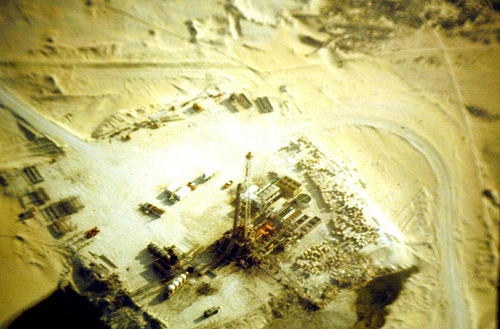
Ansarullah says it struck Saudi Arabia six times in 48 hours, naming one of the kingdom’s most remote oil fields, two international airports, Aramco infrastructure and military positions. The breadth of the target list is clear. The success of each claimed operation is not.
What happened
The Houthi statement listed the Shaybah oil field, an Aramco facility in Yanbu, King Khalid International Airport in Riyadh, Abha International Airport, radar installations, military bases and a coalition naval camp. It said ballistic and cruise missiles and drones were used.
Saudi aviation has experienced real disruption during the wider campaign, and previous strikes caused casualties and damage. For this particular 48-hour sequence, flight diversions, alerts and local reports support activity, but do not independently confirm direct hits or the damage described at every site.
Why it matters
Shaybah sits near the UAE border in the Empty Quarter and represents both production capacity and Saudi technological reach. Yanbu is central to Red Sea exports, while airports carry civilians and may also support military logistics.
Combining energy, aviation and military targets pressures the Saudi economy and air-defense inventory. It also increases danger to travelers even when the intended aim point is military.
Six launch events do not necessarily equal six successful attacks. Interceptions, malfunctions and decoys can all produce alerts. Conversely, Saudi restrictions on impact imagery make independent damage assessment difficult.
Ansarullah’s strategic message is that nowhere—from the capital to remote oil fields—is beyond reach. Riyadh’s challenge is to keep civilian aviation and energy exports operating without presenting easy, predictable targets.
Verification and competing accounts
Ansarullah issued a detailed six-operation claim. Saudi disruptions and earlier damage are documented, but independent evidence does not yet verify successful impacts at every target in the latest statement. Sources consulted include Ansarullah military statement, Associated Press, Anadolu Agency, Saudi civil defense reporting, commercial flight and satellite monitoring. Official, military, partisan and anonymous-source claims remain attributed unless independently established.
The target list comes from a belligerent’s communiqué and should remain a claim until satellite imagery, airport records, official damage reports or geolocated footage corroborate individual impacts.
Reading the signal
Every actor has a communications objective. Governments seek confidence and deterrence, armed groups seek momentum, opposition movements seek legitimacy and political leaders seek electoral advantage. Motive does not make a claim false, but it explains why independent corroboration and precise attribution matter.
The assessment may change quickly. Responsible coverage preserves the verified core, labels the contested perimeter and explains what evidence would alter the conclusion. That approach is less theatrical than a viral post, but more useful when readers are judging war, public safety, diplomacy or markets.
Breaking-news language often makes a genuine development sound more conclusive than the available evidence permits. The disciplined method is to separate the observable event, the account offered by an interested government or armed group and the strategic interpretation placed on top. A verified statement proves that words were spoken; it does not automatically prove every operational detail inside them.
Confirmation normally improves through records, imagery, technical data, named witnesses and reporting from sources with different incentives. Until those checks converge, terms such as “reported,” “claimed,” “preliminary” and “unverified” are not evasions. They identify the actual strength of the evidence and protect readers from treating the first narrative as the final one.
Scale matters as much as authenticity. A dramatic threat, viral video, missile claim or diplomatic announcement may be real without transforming the wider balance. Strategic change requires persistence: repeated operational success, measurable disruption, implemented policy, durable financing or behavior altered by the development.
Every actor has a communications objective. Governments seek confidence and deterrence, armed groups seek momentum, opposition movements seek legitimacy and political leaders seek electoral advantage. Motive does not make a claim false, but it explains why independent corroboration and precise attribution matter.
The assessment may change quickly. Responsible coverage preserves the verified core, labels the contested perimeter and explains what evidence would alter the conclusion. That approach is less theatrical than a viral post, but more useful when readers are judging war, public safety, diplomacy or markets.
What to watch next
Watch NASA FIRMS heat anomalies, Sentinel imagery, Aramco production notices, flight cancellations and Saudi casualty statements. Persistent outages would matter more than the number of weapons claimed in a single announcement.