Saudi Arabia, Turkey and Pakistan Sign an Article 5-Style Defence Pact: A New Regional Alliance Takes Shape
Saudi Arabia, Turkey and Pakistan have signed the Mecca Joint Defence Agreement, declaring that an attack on one will be treated as an attack on all three. Turkey says the clause is technically comparable to NATO’s Article 5, though the pact allows flexibility over the form of assistance.
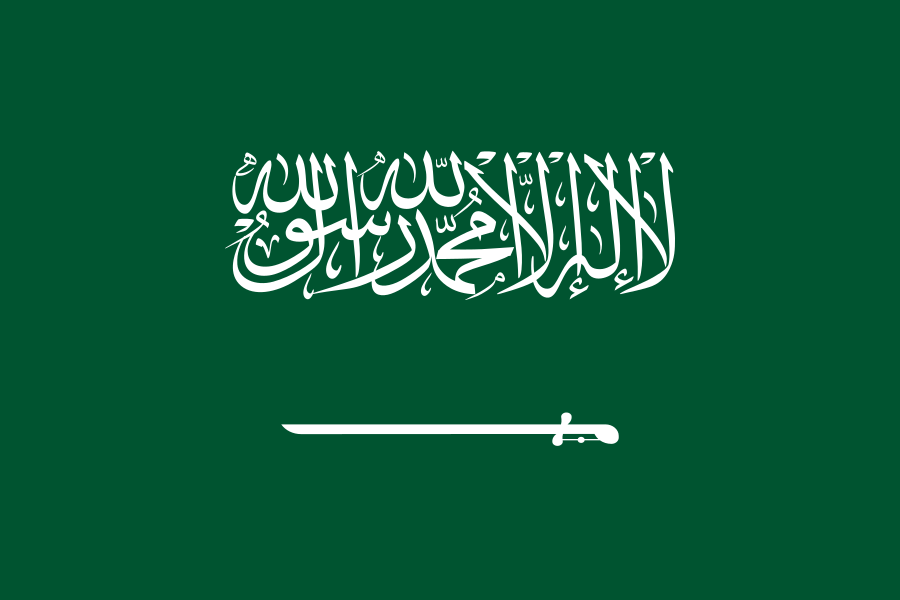
Saudi Arabia, Turkey and Pakistan have formally signed a trilateral mutual-defence agreement that treats an attack on one signatory as an attack on all three.
The Mecca Joint Defence Agreement was signed after years of negotiations and is the most significant institutional security pact yet linking the three countries.
Turkish Foreign Minister Hakan Fidan has described its mutual-defence clause as technically comparable to NATO’s Article 5.
That comparison is important.
It should not be interpreted as meaning the new pact is structurally identical to NATO.
The agreement commits the three governments to collective defence but allows consultation over the form and level of assistance.
That assistance could range from intelligence and logistics to military deployment.
A permanent secretariat in Saudi Arabia and regular ministerial coordination are intended to give the agreement an institutional structure rather than leaving it as a symbolic declaration.
The timing is impossible to separate from the Iran war.
Saudi Arabia has faced missile and drone threats from Iran, Iraqi militias and the Houthis.
Pakistan borders Iran and has its own security concerns.
Turkey is a NATO member trying to expand strategic autonomy and influence across the Muslim world.
All three countries have reasons to reduce dependence on Washington without necessarily breaking with the United States.
That makes the agreement potentially more important than a simple anti-Iran bloc.
Fidan has explicitly said the pact is not directed against Iran or any other specific country.
That is diplomatically necessary.
Pakistan needs workable relations with Tehran.
Turkey competes with Iran in Syria and elsewhere but also trades with it.
Saudi Arabia itself has spent years trying to prevent open war with Iran.
The agreement is therefore better understood as a collective-security architecture that can be activated against multiple threats.
Its nuclear dimension will attract immediate attention.
Pakistan is the only nuclear-armed member.
There is no public evidence that the pact automatically extends a Pakistani nuclear guarantee to Saudi Arabia or Turkey.
Claims of a formal nuclear umbrella should therefore be avoided unless the treaty text says so.
The conventional capabilities are already substantial.
Turkey has drones, missiles, an expanding defence industry and a large military.
Pakistan brings manpower, air power, missile capability and decades of defence cooperation with Saudi Arabia.
Saudi Arabia brings financing, strategic geography and advanced Western equipment.
Together, they could build integrated air defence, intelligence-sharing and maritime capabilities.
The pact also interacts with NATO.
Turkey remains a NATO member and is still bound by Article 5 obligations there.
The new agreement does not automatically supersede those commitments.
A crisis involving conflicting partners could nevertheless create difficult political choices.
Suppose Saudi Arabia invokes the pact after an Iranian attack while NATO members oppose escalation.
Ankara would have to balance two alliance systems.
The agreement may expand.
Turkey has already suggested Egypt as a possible future participant.
If Cairo joins, the pact could become the core of a much larger regional security structure.
That would increase its strategic weight and its internal complexity.
Egypt, Turkey, Saudi Arabia and Pakistan do not always share priorities.
Collective defence works only when members agree on what counts as aggression and what risks they are willing to accept for one another.
The pact’s credibility will therefore be tested not by the signing ceremony but by implementation.
Joint exercises, integrated planning, command procedures and actual crisis coordination will reveal whether the alliance is real.
The open question is whether the Mecca agreement becomes a durable Middle Eastern and South Asian security system—or a powerful political declaration whose members discover that “an attack on one is an attack on all” is much easier to sign than to enforce.